During my time in Amsterdam, I naturally wanted to see some unusual places — the kind you won’t easily come across anywhere else. Friends of mine recommended exactly that kind of place. Welcome to the Wynand Fockink tasting house!
What makes this place interesting isn’t just the atmosphere — it’s the business model behind it.
Let’s start with this: the model’s effectiveness has been proven over 336 years of existence. Take a moment with that — Wynand Fockink has been operating, unchanged, in exactly the same spot since 1679, just 100 metres from Dam Square in the heart of Amsterdam.
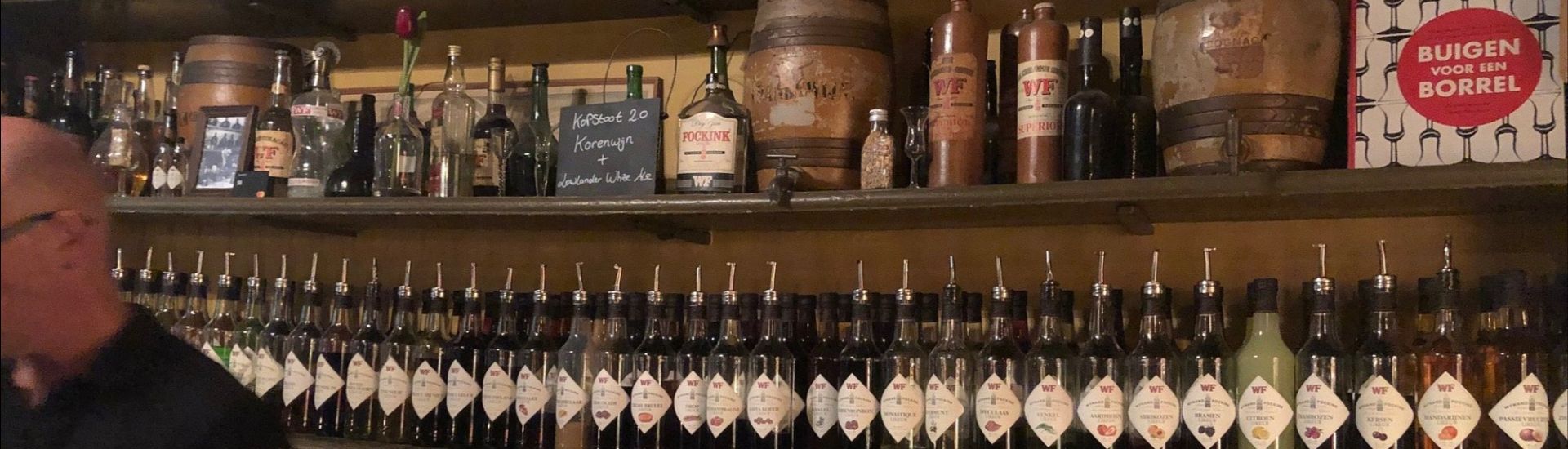
Another thing that makes this place stand out is its range — over 100 varieties of liqueur. They are made from natural fruit juices, and the recipes are kept just as secret as Coca-Cola’s.
The authentic interior only reinforces how old the place is. Some of the bottles are coated in dust that’s been sitting there for what looks like a century. I imagine a Western European health inspector would have a quiet breakdown seeing it.
Selling a shot here is an entire ritual — practically a mini-performance. The bartender first asks what flavour you’re after, cracks a joke, tries it himself, and then lets you taste a sip of a few different varieties. Once you’ve picked one, the real fun starts: the drink is poured into a special tulip-shaped glass, filled right to the brim and beyond — so full that picking it up is simply not an option. That’s exactly why guests lean over the counter and carefully sip from where it stands.
The tasting room itself takes up just 12 square metres, with a small shop next door covering another 13, where you can buy your favourite drink in 0.35L or 0.5L bottles. The liqueur production happens right behind the wall. The tiny space naturally creates a queue, a buzz, and a real sense that this place is in serious demand.
So, let’s add it all up:
- Tasting room + shop = 25 square metres;
- Two bartenders and one shop assistant;
- Opening hours: 3pm to 9pm!
- A shot costs €3, a bottle €12–20.
And those 25 square metres generate more than €4 million in revenue a year!
Looking at this place, I started thinking: what if they added more staff to help the bartenders, expanded the space — surely they could make even more money? But I caught myself immediately, because changing anything about the process, the square metres, or the people would mean this stops being Wynand Fockink altogether — it would become a completely different business with a completely different model. Not every business model needs transforming. Sometimes 336 years of doing exactly the same thing is the strongest competitive advantage a business can have.
So how do you actually tell whether your business model needs to change, or whether it’s already running at its peak? Sometimes entrepreneurs miss growth opportunities simply because they don’t notice the weak points in their own model. In other cases, they try to fix something that’s already working perfectly.
To make the right call, it matters to run a proper professional diagnostic of your business model. Want to find out more about how to boost your business’s performance through a business model stress test? Find out more here.
How do you spot in time that your business model is starting to falter — and what do you do about it? Alexander Pankov talks through exactly this in the video.
You might also be interested in

Case study: Building a transformation strategy for an IT integrator
We wanted a strategy to build on — not to be left behind.
Read more All cases
Review of the strategy development project with ALSI Group
One of Alexander's most important and valuable qualities is his ability to ask the team very precise and uncomfortable questions — questions that led to unexpected solutions the team had never thought of before...
Read more All testimonials