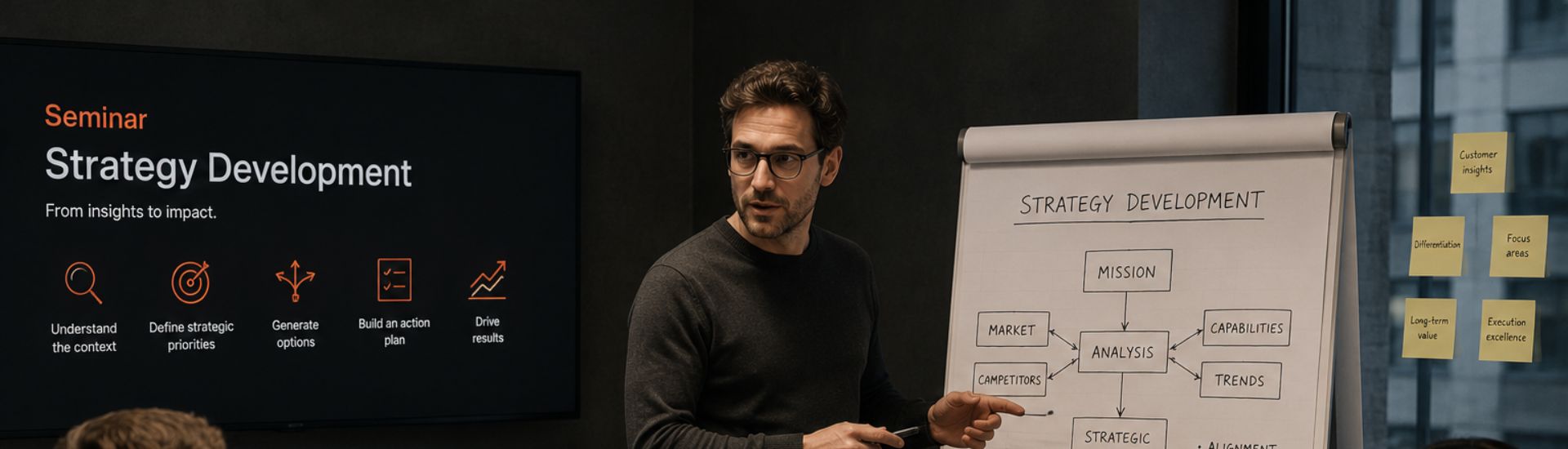
A strategy does not appear when a document is written. It appears when owners and leaders develop a shared view of the company’s future and make aligned decisions about its development.
A program for those who understand that strategy is needed, but are not sure where to start. In two days, you get a step-by-step algorithm for developing and implementing strategy, work through live cases, receive eight original templates, and get a personal consultation with the program author after the workshop.
This is not a theoretical course on “how to write a strategy.” It is a practical program after which you will have the tools to either start building your company’s strategy yourself or enter a strategy development project confidently, with your team or with consultants.
Every business grows for a while on the energy of its founder or owner. Over time, processes become more complex, the team grows, and the goals become more ambitious.
That is when it becomes clear: the company needs a picture of its future and a clear plan for how to get there.
The challenge is that top managers often understand business strategy differently and use different tools when developing it. This creates friction and misalignment at every stage: from shaping the future of the business to implementing the specific initiatives that will lead there.
If you are facing at least one of these issues, it is worth looking at how strategy can help solve it:
- Price battles with competitors are taking too much energy, but you cannot break out of that cycle.
- The business has several owners, each with a different view of the company’s future, and you want to build a shared vision.
- The company is profitable, but growth has been slowing for several years.
- A major new player is entering the market and changing the balance of power in the industry, and it is not clear how to protect the company’s position.
- You need to attract investment, so the business structure needs to be strengthened.
- Shareholders expect growth, and you need to show them realistic options for how to achieve it.
- You want to scale the business and secure growth, but there is no clear understanding of how to do it.

A clear answer to whether your business needs a strategy at this stage of development.

A set of practical tools for developing a strategy that can actually be implemented.

A shared understanding within the management team of why strategy is needed and how to build it.

A map of typical pitfalls: strategy development and implementation mistakes you will learn to avoid.
Program content
- Building a shared approach
- Building the strategy development method
- Building the strategy implementation method
- Building the method for reviewing and adjusting the strategy
- Serious mistakes in strategy development and implementation
Program author and facilitator

Aliaksandr Pankou
Co-Founder of A.maze.S
Concrete decisions, priorities, and tools that help turn strategy development from a set of ideas into a clear action plan for the company.
A step-by-step strategy development plan you can apply in practice.
A selection of major strategic mistakes and ways to avoid them.
Eight original templates for working with strategy.
A personal consultation with the program author and facilitator after the training.
Format
Offline or online
Two days of active group and individual work (20 academic hours).
When the online format is selected, we usually split the training into half-day sessions with breaks between them.
Theory and practice: 40/60
Practical exercises are based on live cases from the program author.
Shared chat
Trainer support, Q&A communication, and experience sharing with peers.
Who the program is for
- Business owners.
- Top managers.
- Heads of marketing.
- Business unit leaders.
- Managers responsible for business development.

Learn more about the program

You May Also Be Interested In

Checklist: «Does your company actually have a strategy?»
Our checklist will help you quickly assess whether your company genuinely has a complete strategy in place.
Read more All articles
Case Study: Management Training Program for Resolut’s International Team
When a company scales quickly, management gaps become costly. This is the point at which structured management stops being a formality — and starts being the foundation that protects quality, pace, and the team's capacity to sustain it.
Read more All cases
Review of the management competency development program from Resolut
What is especially valuable is that the work didn't end on the last day of the module. Alexander continues to give participants challenging management tasks to this day, and periodically we all discuss the solutions together with Alexander.
Read more All testimonials