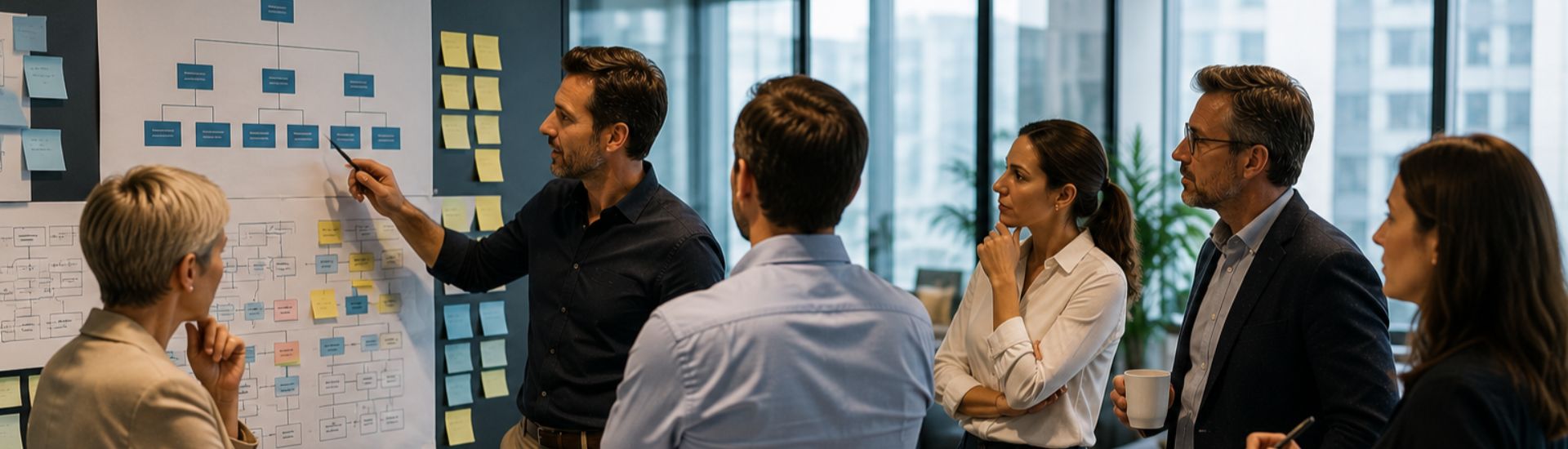
Leaders change, new KPIs are introduced, motivation programs are launched, and business processes are reviewed. Yet decision-making remains slow, accountability is blurred between departments, and strategic initiatives require disproportionate effort to implement.
Most often, the root cause is not individual decisions or individual employees. It sits deeper: in the company’s management system, in how responsibility and authority are distributed, how departments interact, and how the organizational structure supports or limits business development.
We redesign the organizational structure together with the management team, not instead of it. This matters: a structure the team helped create is implemented with much less resistance.
Why structural problems are so hard to recognize
Structural problems rarely look structural. They look like staffing issues, motivation issues, communication issues, anything but system issues.
Decisions take too long because authority is not placed where accountability appears.
Departments compete for resources and influence because the company’s organizational logic creates conflicting goals and incentives.
Strategy gets stuck during implementation because the organizational structure does not support the scale and complexity of the business.
The owner remains the center of most important decisions because the company has grown faster than its management system.
Companies can spend years treating symptoms: hiring, training, motivating people, and still getting the same results. Because they are changing people inside a poorly designed system. The system remains.
An organizational structure is not a chart in Visio. It is how power, responsibility, and information are distributed. When the structure does not fit the business model, scale, or goals of the company, no HR effort can fully compensate for it.

Constant conflicts between departments over resources, areas of responsibility, or customers. You resolve it in a meeting, and a week later it starts again.

Most decisions are made only at the very top. The leader is overloaded, and the team cannot move without them.

Some tasks are “not mine” for everyone. Accountability is formally assigned, but in practice no one owns the result.
Strategic goals are not achieved, even though everyone is working, and often overworking.

High management turnover. Good people leave not because the company is bad, but because they do not understand what is expected of them or how they are evaluated.

Any change takes painfully long to implement: approvals, discussions, revisions, and still only a partial result.

The company keeps living off old products, while new ones remain a topic for discussion.

Each next stage of growth is harder for the company than the previous one.
A structure does not become outdated only when things are going badly. Sometimes it simply stops matching the new state of the business and slows down growth that could otherwise happen.
Reasons to redesign:
The organizational structure developed gradually rather than being deliberately designed.
Each change made sense at the time, but over time many compromises accumulated and started reducing speed, transparency, and management effectiveness.
Organizational debt has become too expensive for the company.
Communication becomes more complex, approvals multiply, decision-making slows down, and the business becomes increasingly dependent on individual leaders.
The company has developed a new growth strategy.
Entering new markets, launching new business lines, moving to a different business model, or setting new strategic goals requires a review of responsibility, authority, and coordination mechanisms.
The company is preparing to scale.
Sustainable growth requires an organizational model that can support increased activity without losing manageability or decision quality.
The owner has decided to change their role in the company.
Moving from operational management to strategic leadership requires a system of responsibility and authority that can deliver results without the owner’s constant involvement in day-to-day work.
How we work
Redesigning an organizational structure is always a unique process. There are no universal templates: what works for a 50-person trading company will not work for a 2,000-person manufacturing holding. That is why the project plan is developed individually for the client’s task and based on their strategic goals.
The key principle of our approach: we work with the management team, not instead of it. The new structure is developed jointly through organizational development sessions, working groups, and interviews. This solves two tasks at once: finding a structure that truly matches the business goals and ensuring the team accepts the changes without resistance.
A team that participated in the design understands the logic. That means it implements the solution rather than blocking it.
Why “drawing a new org chart” does not solve the problem
One of the most common mistakes in organizational redesign is treating the structure as a graphic reporting chart. As a result, the new structure is built on leaders’ personal experience, examples from other companies, or organizational models that once worked in completely different conditions.
Organizational design is a management discipline with its own principles, patterns, and constraints. An effective structure is defined not by the preferences of individual leaders, but by the company’s strategy, stage of development, business model, business complexity, required decision-making speed, and the nature of interaction between departments.
The situation is made more complex by the fact that designing an organizational structure almost always affects the distribution of power, authority, resources, and responsibility. Discussion of the future management model inevitably brings conflicting interests between functional leaders, departments, and business units. In these conditions, participants often protect the interests of their own areas, influence zones, or established management practices rather than the interests of the company as a whole.
That is why an effective organizational structure rarely emerges from the work of one leader, HR director, or consultant behind a closed door. It should be created with the management team’s involvement, while relying on a professional organizational design methodology and a well-managed process of discussion and alignment.
The consultant’s role in this project is not to propose a ready-made chart. It is to provide an objective analysis of business needs, help leaders see the whole system, resolve conflicting interests constructively, and develop an organizational model that supports the company’s strategy and is perceived by the team as its own decision.
Only then does the new structure become not a formal document, but a real management system that is implemented in practice and gives the company room for further growth.
Stages of work
- Stage 1. Organizational diagnostics and analysis of management system requirements
- Stage 2. Designing the functional and organizational structure
- Stage 3. Adapting the organizational structure to the company’s people potential
- Stage 4. Defining management roles and structural documentation
- Stage 5. Setting up coordination and decision-making mechanisms
- Stage 6. Setting up the company’s financial architecture
The main result of the project is not a new org chart, but an integrated management system that can implement strategy, support business growth, and improve the speed and quality of management decisions.

Improved business manageability
The company starts working through a system of responsibility, authority, and coordination, rather than through the owner’s constant involvement in operational issues.

Faster decision-making
Most decisions are made at the level where accountability for the result appears, which reduces approvals and management delays.

Greater leadership accountability
Each key function, process, and business result receives a specific owner responsible for achieving the agreed goals.
Lower dependence on individual people
The company becomes more resilient to people changes, while knowledge and responsibility move from personal agreements into the management system.

More effective interaction between departments
Duplicate functions, responsibility gaps, and chronic conflicts between departments caused by an imperfect organizational model are removed.

Faster implementation of strategic initiatives
New products, projects, and changes receive a clear coordination system and move faster from idea to implementation.

Conditions for scaling the business
The organizational structure and management system begin supporting further company growth without a proportional increase in management complexity.

Transparency of each department’s contribution to the company’s financial result
Management can see the cost of individual functions, departments, and business areas, understand their contribution to financial results, and make decisions based on objective data rather than assumptions.
Project expert

Iryna Sotnikava
Co-Founder of A.maze.S

Tell us about your situation. During the first consultation, we will look at the symptoms and say whether this is a structural issue or whether the task should be solved differently.

You May Also Be Interested In
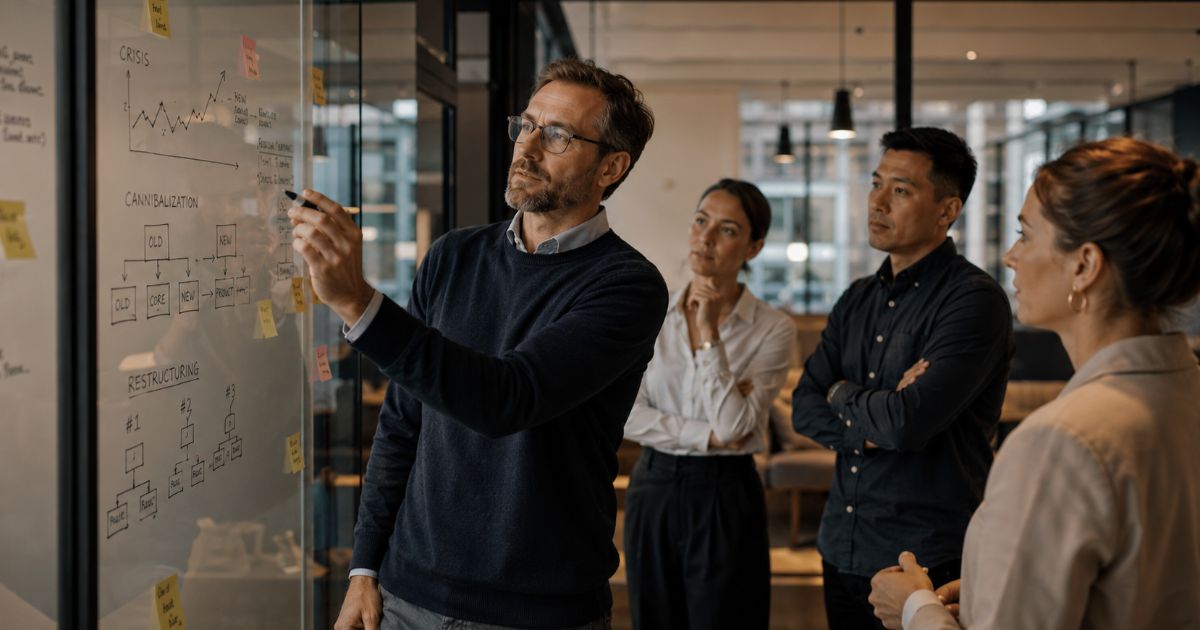
Case Study: How a company navigated three waves of strategic transformation, retained its entire team, and became a product-led business
An inside account of the engagement — from the perspective of the consultants who guided the organization through successive crises, deliberate self-disruption, and three structural rebuilds.
Read more All cases
Review of strategic transformation from Atlant-M automobile distributor
We have been working with Irina using the Adizes methodology for 5 years already, and the very fact that we have never even considered changing our partner speaks to our complete satisfaction with the results.
Read more All testimonials
How to restructure your organisation: a company readiness check-up
The way roles, accountability, and communication are structured determines the speed of decision-making, the quality of processes, and ultimately the competitiveness of the company.
Read more All articles