Every day, owners and top managers face not only management difficulties, but also their impact on the business. In some companies, growth slows down, profit stops increasing, new products fail to take off, promising projects get stuck, strong employees leave, and market opportunities remain unused. In others, the business grows so quickly that leaders can no longer keep up with the volume of decisions, departments start working out of sync, processes lag behind company development, and what used to be an advantage becomes a source of new problems.
Some companies spend years unable to break through a certain ceiling. Despite new ideas, investments, and team effort, growth slows, profit does not increase, and strategic initiatives do not produce the expected results.
Others, on the contrary, grow so quickly that the existing management system can no longer handle the new scale of the business. Leaders are overloaded, decisions are made more slowly, departments work out of sync, and change becomes more complex and expensive.
Despite different symptoms, the cause is often the same: the key elements of the management system have stopped working together.
You can develop a strong strategy, create an effective organizational structure, introduce modern metrics, and build a motivation system. But if these elements are not aligned with each other, each of them starts working against the others.
Strategic transformation is a comprehensive change of the company’s management system. We do not simply improve separate management tools. We help align strategy, organizational structure, distribution of responsibility and authority, decision-making and execution processes, the financial model and budgeting system, information flows, metrics, motivation, and management culture so that all elements work toward shared company goals instead of contradicting each other.

The business has stopped growing. You continue doing what used to bring results, but the company can no longer break through the next stage of development.

Or the opposite: the company is growing so quickly that the current management system can no longer cope.

Leaders are overloaded, decisions are made more and more slowly, departments work out of sync, and change becomes increasingly difficult.

You have tried to change the situation more than once: developed a strategy, redesigned the organizational structure, introduced KPI or OKR, automated processes, and invited consultants. But after a while, the company returned to the same problems.
Problems appear in several parts of the company at the same time. Strategy execution gets stuck, leaders are overloaded, departments conflict, decisions take too long, and the owner gets pulled deeper into operations.

You understand that changing one process or department is not enough. The whole management system needs to change, but it is not clear where to start or how to make sure the changes do not contradict each other.

The company has everything that is considered “right”: a strategy, organizational structure, budgeting, decision-making system, metrics, and motivation. But together, they do not work.

You increasingly feel that the company is capable of much more than it shows today. The opportunities are there, the team is strong, the market is developing, but internal constraints prevent this potential from being realized.
These constraints are difficult to see from inside the company. Each element may look logical and effective on its own. There is a strategy. There is an organizational structure. Budgeting works. Metrics are defined. But the constraints appear not inside individual elements, but in how those elements are connected. That is why local changes rarely create a sustainable result.
The most serious business constraints arise not inside individual elements of the management system, but in the links between them.
What kind of companies is transformation right for?
Strategic transformation is right for companies that want to reduce their dependence on the owners’ constant involvement in operations. We understand that owners are often overloaded, and the business cannot develop if everything depends on them. We help you build a management system, set up delegation, and create a structure that supports the business in the long term while preserving your control and distributing responsibility across the management team. We stay with you at every stage, not only advising, but helping implement changes that actually work.
How is a transformation program designed for a specific company?
Every company goes through its own transformation path. That is why the project scope is always defined by the starting situation, company goals, and the constraints that need to be removed.
In some cases, transformation includes the full cycle of change: from diagnostics and strategy development to redesigning the management system and supporting implementation.
In other cases, it is enough to implement only the stages the company truly needs right now.
For us, transformation is complete not when documents have been developed, but when the new management principles become familiar practice for leaders and employees.
Stages of strategic transformation:
- Developing the owners’ vision
- Organizational diagnostics
- Implementing the change program
- Strategy development
- Organizational structure development
- Developing the planning, budgeting, and metrics system
- Developing the reward system for the management team
It is important to understand that the stages of strategic transformation are not implemented in a strictly linear sequence. Many of them run in parallel, and their sequence and depth depend on the company’s starting situation and the results of previous stages.
The active phase of management system transformation usually takes 12 to 18 months. This timeframe is not driven by the complexity of the methodology, but by the need to make changes without stopping operations and while accounting for the real workload of the management team. Our task is not just to develop a new management system, but to help the company consistently embed it into daily practice.
Some companies deliberately choose a more comfortable pace of change and spread the work over a longer period. This helps reduce pressure on the management team and carry out transformation carefully without losing the quality of change.
After the active phase is complete, we can continue supporting the company if needed, helping consolidate changes, develop the management system, and keep it aligned with new business tasks.
Stability and adaptability
The company receives a management system that can adapt to new tasks without being rebuilt from scratch every time. Market changes, new products, new markets, leadership changes, or a new development stage stop becoming a crisis because the management system can change together with the business.
Growth without organizational chaos
The company gains the ability to grow without constantly increasing management complexity. New employees, departments, products, and markets become part of a working system instead of becoming a source of new conflicts, leader overload, and slower decision-making.

Predictable strategy execution
Strategic goals turn into specific department tasks, supported by resources, decision-making systems, budgets, metrics, and reward systems. As a result, strategy stops being an intention and becomes a working mechanism for company development.

The owner stops being the main growth constraint
The company stops depending on the owner’s constant involvement in daily operations. The organization becomes capable of solving most operational issues independently. This allows the owner to spend more time developing the business instead of dealing with the consequences of an imperfect management system.

Fast decision-making and implementation
Decisions stop getting stuck between management levels and departments. Clear responsibility, authority, transparent decision rules, and a shared understanding of priorities help the company not only make decisions faster, but also implement them much more effectively.
A new management culture
Changes affect not only processes and structure, but also how people interact. Collaboration, accountability for shared results, and constructive problem-solving become a natural part of daily work because this behavior is supported by the new management system.
What we do NOT do in transformation
- We do not “transform in one quarter.” If a company has been growing for 10 to 15 years, it cannot be rebuilt in three months.
- We do not “deliver the result and leave.” We stay alongside the team throughout the change period.
- We do not work with companies where the owner or CEO has “delegated transformation to us” but is not personally involved. Without first-person involvement, the project cannot be implemented.
Where to start
Before entering a comprehensive project, we always start with a 60 to 90 minute conversation. You tell us what is happening and what you have already tried. We will say honestly whether transformation fits your situation or whether it makes sense to start with one specific step, such as strategy development or organizational diagnostics. Entering transformation just because it is a popular word is a bad idea, and we will be the first to say so.

Tell us about your situation

Project consultants

Aliaksandr Pankou
Co-Founder of A.maze.S

Iryna Sotnikava
Co-Founder of A.maze.S
Get to Know Our Work
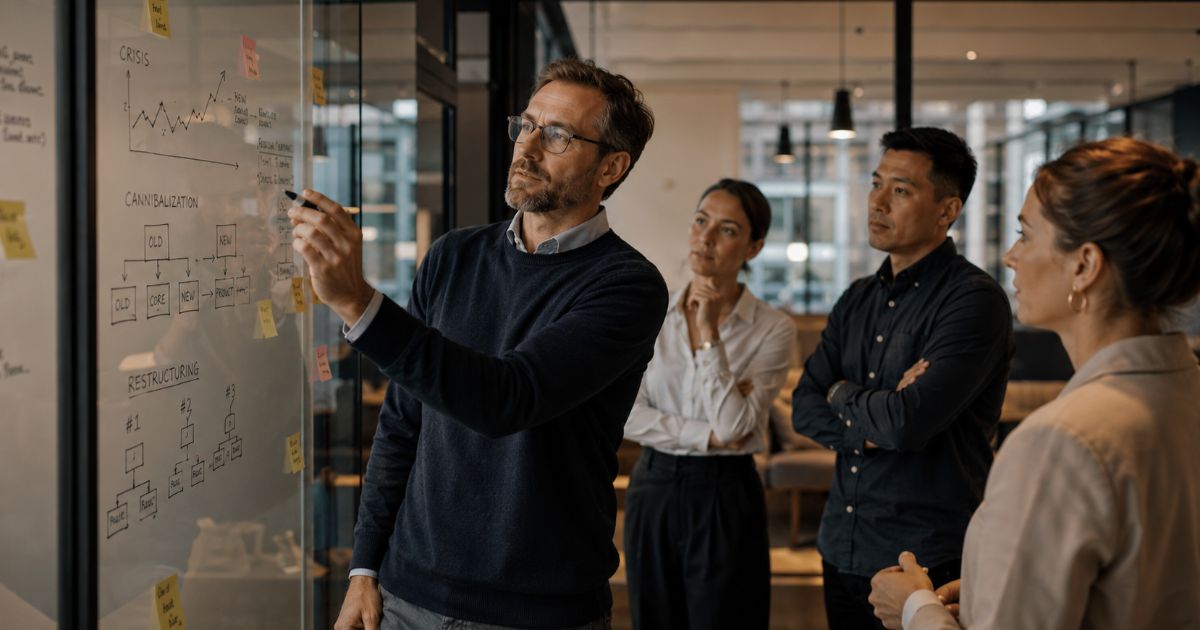
Case Study: How a company navigated three waves of strategic transformation, retained its entire team, and became a product-led business
An inside account of the engagement — from the perspective of the consultants who guided the organization through successive crises, deliberate self-disruption, and three structural rebuilds.
Read more All cases
«A durable integration skill helps a business handle any problem»
Every business problem is systemic in nature. They come from how companies respond to change — and that response leads to disintegration. We mean disintegration of everything and everyone: the interests of people, including owners and leaders, as well as business processes, organisational structure, the reward system, employee authority, and individual departments.
Read more All articles
Review of the change implementation project from Discovery group of companies
When we entered the project with Irina Sotnikova and the A.maze.S team, we understood: if we wanted to reach a different level of business, we needed a completely different approach to how the company itself was structured.
Read more All testimonials