Every leader, at least in their dreams, aims for the ideal company: a properly built structure, a great team, an effective reward system, well-running processes. And, of course, a strong development strategy. Some even manage to get there, after putting in serious effort. But before long, change starts happening, and that carefully assembled picture breaks apart into pieces, and conflict appears. At the core of nearly all of these business problems is disintegration — the thing that makes it so hard to put the pieces back together as a whole. Irina Sotnikova, an organisational development expert, consultant, and co-founder of A.maze.s, explains how Dr. Adizes’s methodology helps companies build a durable skill of integration.
— As we know, the Adizes Institute works with companies in nearly 80 countries, and over recent years the methodology has only kept growing in popularity, especially in Eastern Europe. A great many companies around the world use the Adizes approach and see genuinely visible change as a result. What exactly are these approaches? What’s the real «secret sauce» of the methodology — its key distinguishing features?
The thing is, every business problem is systemic in nature. They come from how companies respond to change, and that response leads to disintegration. And we mean disintegration of everything and everyone: the interests of people, including owners and leaders, as well as business processes, organisational structure, the reward system, employee authority, and individual departments. Large companies, especially fast-growing ones, experience the most disintegration of this kind. And if you look closely at almost any problem, you’ll find it emerged because something that was once whole has come apart into pieces — disintegration in action. And eventually, the business itself becomes disconnected from its own market.
What’s the actual nature of a crisis, or of any difficult moment in the economy? Broadly speaking, all of them happen because the pace of change is faster than usual. And the change is significant enough that a company simply can’t afford to ignore it. If internal disintegration already exists, the company has no energy — or not enough of it — to integrate with the market. So we see the organisation become rigid: trouble implementing change, trouble managing projects, trouble building employee engagement, and so on. The company can’t respond to the situation, and the reason is genuinely simple: the disintegration of the whole.
What «whole» are we talking about? In the Adizes methodology, it consists of four core building blocks.
- People.
- Processes (not just business processes, but decision-making processes too).
- Structure (made up of how responsibilities are split between employees, their authority, and the reward system).
- Mission — a genuinely important block for any business, and one whose value owners frequently underestimate. People, after all, want to work for an organisation that delivers genuine value to the market — not just one that generates profit for its owner.
Disintegration that occurs within these four blocks — and between them — significantly reduces the organisation’s ability to integrate with the market.
It’s a common assumption that people respond to change with fear and distrust. And that’s true. Why? Because people sense that change will disintegrate something whole — something that will then be genuinely hard to put back together. And many have lived through exactly that. We often start improving something, breaking existing connections, and then forget to reconnect those pieces with the rest of the whole. Over time, companies accumulate that kind of experience. Beyond that, things like company size and the speed of its development matter too.
Some might conclude that the answer is to simply not change anything in the company at all. But does that actually work? We can absolutely build perfect business processes, hire highly qualified people, design an effective reward system. It’s entirely possible to build a perfect structure and a perfect strategy. But sooner or later, some change happens — and the whole perfect picture falls apart into pieces all over again, disintegrated once more.
So how do you actually handle this? Say we’ve poured enormous resources into building a successful company. But how does it stay successful and keep developing? The answer is simple: every company needs a durable skill of integration. Think of it as comparable to literacy in an educated person. Disintegration happens — the company integrates again. And on it goes, link by link. So how do you actually build this skill?
Ichak Adizes developed an organisational transformation system made up of 11 stages. Over the course of this transformation, the company builds that durable integration skill.
A company’s first time going through the programme can be difficult, unfamiliar, and fairly long — up to a year or two. But the steps after that come more easily and deliver greater impact.
At the very start, external consultants specially trained in the Adizes methodology help guide companies through it. Later on, employees inside the organisation take ownership of all the relevant techniques, and the company starts driving the change itself, building its integration skill independently. It’s hard to believe, but within a single year a company can change its structure, roll out a new reward system, rework its financial flows, improve management accounting, build a strategy, and resolve personnel issues. And all of this happens at a calm, steady working pace, without conflict and without serious upheaval. Sounds impossible? Now imagine this is also a large company, with a workforce numbering several thousand. It’s genuinely achievable — and there are plenty of real examples of it.
Let me walk through the 11 stages of transformation in more detail.
- Synergetic diagnosis. The idea is to bring the company’s senior leaders and key specialists together to discuss the business’s core problems. Participants identify cause-and-effect relationships and begin actively working on the problems they’ve surfaced. What’s more, they own the problems — meaning that from this point on, there are no more «his,» «her,» or «their» problems in the company. Only «ours.» That psychological shift matters a great deal. The second piece is that employees get a real surge of energy to actually tackle these problems. Implementing change in a company is often genuinely hard, requiring enormous effort. When people understand what they’re pushing for and have the energy behind them, everything goes far more smoothly. Implementation usually struggles precisely because we haven’t prepared properly, haven’t worked through the key points, and haven’t gotten the people involved genuinely invested.
- By now we already have a list of problems, priorities, and an action plan. Next, we start forming teams made up of department heads. This is where the actual learning of integration begins — because we’re bringing together people who don’t usually interact much at all. That might mean an accountant and a production manager. Or an engineer and a salesperson. At this stage, they’re genuinely invested in solving specific problems, and they have the resources they need. Together, they start acting according to a defined process. This is usually not just one team but several — the number gets decided by the company’s leaders, depending on how stretched employees are and how engaged they are with the change. What do we see over the following six months? These people jointly solve a large number of problems that had been sitting unresolved in the company for years. And in the process, they learn to accept their colleagues’ problems too, understanding that if someone was holding back a necessary decision, they probably had genuine reasons for it.
- This stage genuinely runs in parallel with the previous one. While the teams are solving problems, someone needs to handle coordination, set priorities, review outcomes, and provide oversight. That’s the role of a specially created governing body. We’re not talking about the usual executive body that monitors and punishes here. Adizes doesn’t actually rule out the need for top-down authority during implementation, but according to his methodology, decisions themselves need to be reached democratically. This special body, responsible for development, is what’s called the organisational development committee. It coordinates the work, decides on forming new teams, and sets deadlines for solving problems. Every team leader submits a monthly report to the committee on what their team has achieved. In this way, over six to eight months, the company resolves a substantial number of genuinely thorny problems. There’s no deep restructuring happening yet — we’re not touching the reward system or the company’s structure at this point. This stage matters because people build real experience of solving problems together and seeing positive results come from it. That builds mutual respect and trust among employees. And that, in turn, gives the company the resource it needs to carry out more substantial change.
- Next, we need to look ahead to the company’s future, so we can later start changing the structure. At this point, we’re not yet talking about a complete strategy — more a vision of the future with some elements of strategy in it. At this stage, that’s enough to start the conversation about structure.
- And here’s the core idea of this stage: how do you get the «troops» ready, so they can then march in the right direction toward implementing the strategy? Structure comes first, and changing it takes time. So we work on structure: distributing functions and authority in line with that vision of the future.
- Working with information: adjusting the financial and accounting structure. The new structure is now in place, and we need to set up the information flows to match it, so department heads can actually be held accountable for the results we expect from them.
7–10. The stages that follow are all about improving on the results achieved so far. This includes what’s sometimes called «wringing out» the company — squeezing out everything unnecessary, much like wringing out a damp towel. At this point, the organisation is at the peak of its effectiveness, which makes genuinely outstanding results possible. We also cascade the change downward through these stages — to lower levels, to subsidiary units.
11. In the final stage, we make significant changes to the reward system for key employees. And by this point, we genuinely have the opportunity to build a system that accounts for the interests of every specialist, balancing out any distortions that may have crept in during the change process. It matters that people were told from the very beginning that this was where things were heading.
After going through all 11 stages of transformation — which takes around a year — we start the cycle again. And eventually, over time, the company genuinely acquires this skill, becoming well-trained when it comes to change. There’s a saying that implementing one major change every ten years is practically unbearable. But in our case, where the company is changing constantly, that becomes simply its way of life. No external shift will trigger major upheaval any more — the company adapts quickly and integrates with the market. No crisis will be able to knock it off course.
You might also be interested in
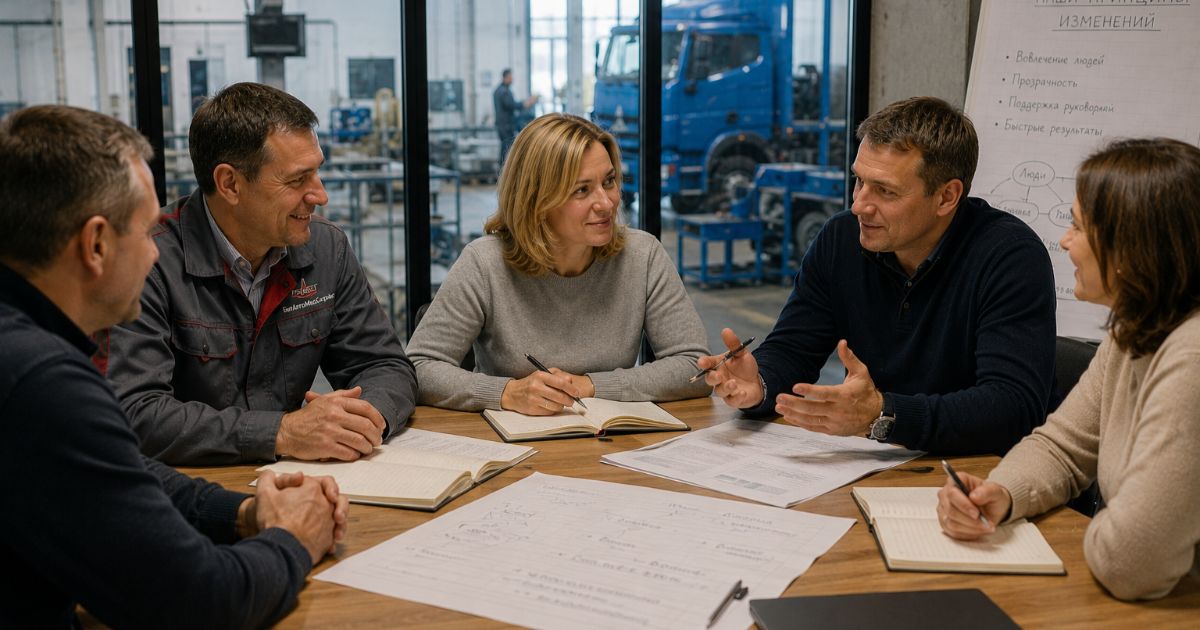
Case Study: How BelAvtoMazService Turned Change Implementation from a Project into Part of Its Management Culture
The main result was the company's ability to independently develop its own management system and adapt it to changing external conditions.
Read more All cases
Review of the change implementation project from Discovery group of companies
When we entered the project with Irina Sotnikova and the A.maze.S team, we understood: if we wanted to reach a different level of business, we needed a completely different approach to how the company itself was structured.
Read more All testimonials