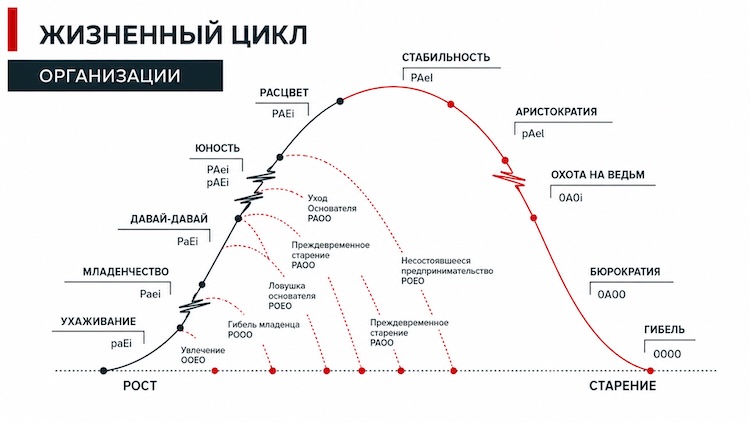
The Adizes methodology treats an organisation as a living organism, moving through different stages of growth and ageing. Understanding which stage your company is currently in helps owners and senior leaders make well-grounded strategic decisions, adjust processes for effective functioning, and steer the company toward a sustainable path of development. In this article, we will walk through the key characteristics and recommendations for each stage of an organisation’s lifecycle.
According to Adizes, every company moves through several stages of development:
- Courtship
- Infancy
- Go-Go
- Adolescence
- Prime
- Stability (or Late Prime)
- Aristocracy
- Recrimination (or Early Bureaucracy)
- Bureaucracy
- Death
1. Courtship
At this stage, the business idea is taking shape and the founder is full of energy. This is a phase of vision and conceptualisation, when it matters to set the direction and build out the company’s vision.
Characteristic features: The idea is still being discussed, and the founder is developing the vision and assessing the prospects.
Possible problems: A lack of concrete action, too much time spent theorising, and a business model that hasn’t yet been worked out.
Recommendations: Assess how realistic the idea actually is, identify the resources you have, and put together a plan for the first steps toward the next stage. Even at this point, it is often worth thinking through the basic elements of the business model — this helps avoid unnecessary costs at launch.
💡 Tip: Assess your resources and risks so you can be confident the idea will hold up before you launch.
2. Infancy
At this stage, the founder’s full involvement matters most, since they are the company’s main driving force. The emphasis here is on survival and actively chasing the first clients, with the core task being to minimise costs and risk. Organisational structure and process are secondary at this point — the focus is on revenue and growth.
Characteristic features: The founder is actively involved in everything, often effectively standing in for the team. Structure and process are practically non-existent.
Possible problems: Heavy dependence on the founder, a lack of order, and no formal processes.
Recommendations: Start bringing in specialists and begin handing tasks over to the team.
💡 Tip: Stay focused on sales and operational survival, without getting distracted by premature formalisation.
3. Go-Go
At this stage, the company is growing fast, but the structure often lags behind the pace of the business. It becomes important to build a clear business model and lock in the key processes. This is a period of full engagement, when it matters not just to grow revenue, but to lay the groundwork for long-term stability.
Characteristic features: The business is growing, and the increase in workload often outpaces the development of the structure. Team enthusiasm runs high, but manageability is weak, and there’s little time left for planning.
Possible problems: Overloaded staff, risk of burnout, resources wearing thin, chaotic processes, and instability caused by a lack of systematisation.
Recommendations: Begin building a stable business model, structure the key processes, and establish rules for how people work together inside the company.
💡Tip: Put basic rules and structure in place to support the company’s growth — for example, guidelines for how departments work together.
4. Adolescence
At the Adolescence stage, the company runs into the need to build structure and clear business processes. Running an organisational diagnostic and formalising the strategy both matter here. This is a period when important decisions need to be put into a system — which makes the business more resilient to the challenges that lie ahead.
Characteristic features: The need for clear structure and management emerges, and the company gradually stabilises. Formal processes are actively introduced, a company culture starts to take shape, and goals and KPIs are set.
Possible problems: Employee resistance to change, and difficulty adapting to new rules.
Recommendations: Run an organisational diagnostic to identify weak spots, start building corporate culture, and develop strategic planning capability.
💡 Tip: Focus on designing and implementing the processes needed for stable operation. It matters to put in place elements of corporate culture alongside the communication processes.
5. Prime
This is the company’s «golden age» — a stable state with a balance between flexibility and structure. At this stage, it becomes important to put greater emphasis on strategic planning to sustain steady growth. The company needs a clear management system and well-allocated resources. This is the moment for actively pursuing new markets and opportunities.
Characteristic features: Steady growth, high productivity, well-established processes, clear goals and strategy, and strong employee motivation.
Possible problems: The risk of losing flexibility and falling back on outdated ways of working.
Recommendations: Keep up the momentum, invest in developing the team, explore opportunities for diversification and growth, and continually refine business processes and strategy.
💡Tip: Invest in innovation and staying competitive, with a focus on improving internal efficiency.
6. Stability (Late Prime)
This stage arrives when the company is still sustaining its growth, but a shortage of innovative solutions starts to be felt. The organisation remains stable, but its flexibility gradually declines. It becomes important to run periodic organisational diagnostics to identify bottlenecks and reinforce the strategic approach. This can prevent stagnation and keep the organisation competitive.
Characteristic features: Steady development, but declining innovation and a reluctance to make significant changes. The company is more oriented toward maintaining its current level than seeking out new opportunities.
Possible problems: The risk of stagnation, and a slower response to changes in market conditions.
Recommendations: Run organisational diagnostics regularly, and reinforce the strategy through innovation and improved client service.
💡Tip: Keep investing in innovation to maintain the company’s flexibility and relevance.
7. Aristocracy
At the Aristocracy stage, the organisation starts to become more conservative. The emphasis shifts from flexibility toward adherence to formal procedure. The main focus is on preserving the current position and upholding tradition. There is a growing tendency toward excessive formalisation of process, which often suppresses employee initiative.
Characteristic features: The company maintains high standards, but innovation and flexibility are replaced by formal procedure. Emphasis shifts toward prestige, sometimes with excessive attention paid to the company’s status.
Possible problems: Slowing growth, difficulty adapting to new circumstances, and the risk of losing competitiveness.
Recommendations: Introduce new approaches, and motivate employees to seek out and implement innovative solutions.
💡 Tip: Strategy at this stage should focus on adaptation and improving operational efficiency, while avoiding excessive bureaucracy.
8. Recrimination (Early Bureaucracy)
This stage is marked by a growing awareness of the problems building up inside the company — but instead of solving them, the organisation starts looking for someone to blame. Internal conflict and mistrust make strategic decision-making harder, and the company’s performance declines. An organisational diagnostic is essential at this point, to identify the real sources of the problems and chart a path to resolving them.
Characteristic features: Internal conflict is building, mistrust among employees is growing, productivity is falling, and dissatisfaction is on the rise.
Possible problems: Internal friction, falling motivation, and stagnation.
Recommendations: Run a detailed diagnostic to identify the underlying problems, and review the organisational structure and the functions within it.
💡Tip: It matters to uncover the real causes of the problems and de-escalate conflict before trying to move forward.
9. Bureaucracy
At the Bureaucracy stage, the company has essentially lost both flexibility and innovation. Decisions are made extremely slowly, and the structure has become tangled by a complex hierarchy and a maze of regulations. Innovation and development are almost nonexistent, leading to a gradual decline in revenue and profitability.
Characteristic features: A rigid structure that makes adaptation and innovation difficult. Excessive formality and hierarchy, slow decision-making, and high operating costs.
Problems: Low profitability, a lack of client focus, and the risk of decline.
Recommendations: Rethink the management approach, and cut back on excessive process.
💡Tip: Reassess the company’s structure and consider whether radical change is needed to break the stagnation.
10. Death
The Death stage represents the company’s complete decline, when it is no longer able to sustain its operations. The business either stops functioning entirely, or continues to exist formally while no longer generating profit. At this stage, the company is no longer able to adapt to change, and its existence comes to an end.
Characteristic features: Complete stagnation, loss of market relevance, and possible closure. Products and services become obsolete, the target audience is lost, and revenue disappears.
Problems: Business collapse, an inability to take in change, and a complete loss of adaptive capacity.
Recommendations: Either undertake deep restructuring, or — if recovery is no longer possible — wind down the business.
💡Tip: If the organisation has reached this stage, it may be time to look for other opportunities — a change in direction, or new projects that could breathe fresh life into the business.
Conclusion
The stages of the organisational lifecycle in the Adizes methodology are a powerful tool for understanding where a company currently stands — and for identifying the right strategies to keep it functioning successfully going forward.
Understanding these stages helps leaders and owners build the right processes, adapt their strategy, and manage change effectively. But identifying the stage is only the beginning. To move successfully through each one, it matters not just to understand its characteristics, but to know how to lead a team genuinely focused on the company’s growth.
For companies looking to strengthen their management teams and prepare them for the next stage, we offer a corporate seminar — «Building and Developing Management Teams.» This seminar helps leaders and managers understand how to work effectively as a team at every stage of the lifecycle, and builds their management competency.
In addition, to quickly identify where your company sits in its lifecycle, you can take our test — «Express Diagnostic: Adizes Lifecycle Stage.» The results give you recommendations for the company’s future development and help you focus on the key areas for sustainable growth.
* Download the test in the «Quick Tools» section of this page
Get ready for what’s ahead with professional solutions tailored to your company!
You might also be interested in
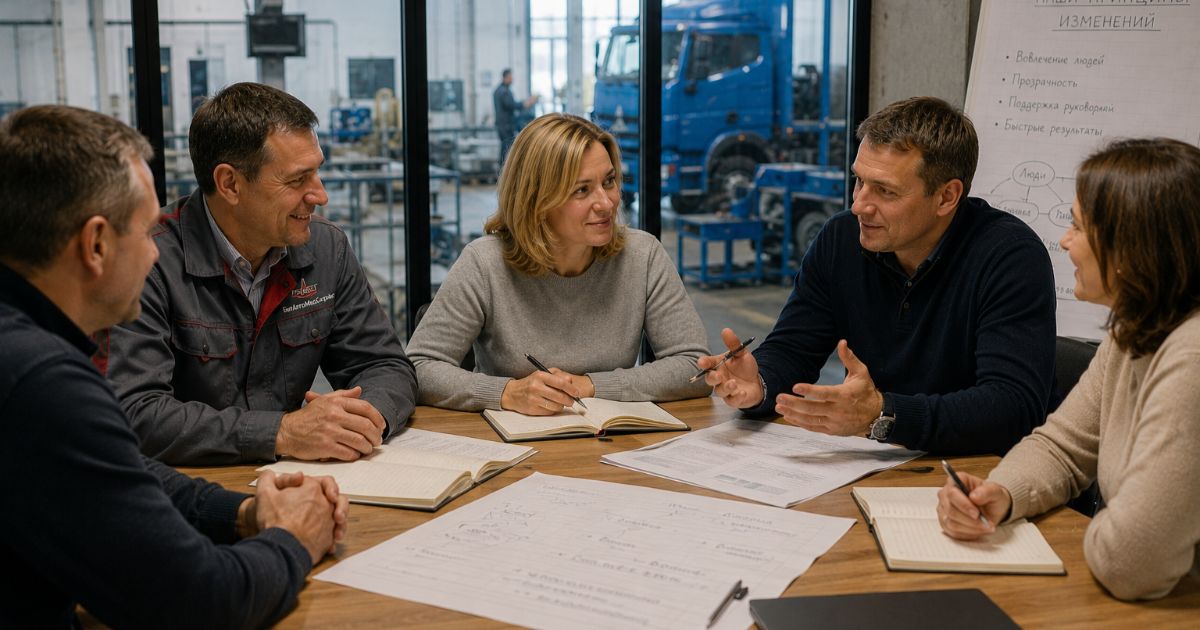
Case Study: How BelAvtoMazService Turned Change Implementation from a Project into Part of Its Management Culture
The main result was the company's ability to independently develop its own management system and adapt it to changing external conditions.
Read more All cases
Review of the change implementation project from Discovery group of companies
When we entered the project with Irina Sotnikova and the A.maze.S team, we understood: if we wanted to reach a different level of business, we needed a completely different approach to how the company itself was structured.
Read more All testimonials