Company context
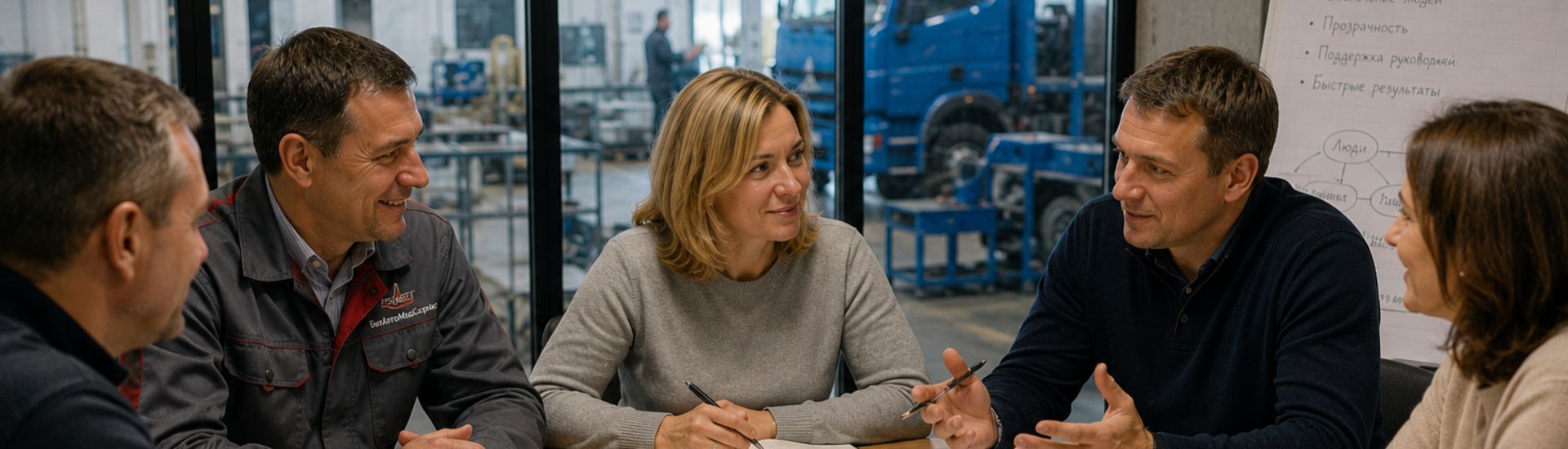
BelAvtoMAZService is an official dealer and partner of leading manufacturers of spare parts for auto and tractor equipment from the CIS, Europe, and China. The company specializes in supplying spare parts and servicing equipment, helping clients minimize downtime and maintain the stable operation of their transport and production processes.
Over the years, BelAvtoMAZService has built a well-developed network of stores and service stations across the CIS and become one of the notable players in its market.
But as the business grew, so did the complexity of managing it. In an industry where customers expect fast response times, reliable supply, and quality service, it’s not just the product and staff expertise that increasingly matter — the quality of internal management processes does too. This became the starting point for a large-scale program of organizational change. Increasingly, though, leadership found itself facing a situation where local improvements stopped producing any noticeable effect.
The question arose: could the efficiency problems be solved through individual organizational decisions, or did the management system itself need to be rethought?
As the company’s director later put it:
«Local improvements have a very short-term effect. We needed solutions that deliver a longer-lasting result. And for that, you need a system.»
The client’s request and expectations
Interestingly, the project didn’t start with the idea of transforming the company at all. The trigger was a quite specific management task.
The board of directors was discussing the possibility of creating a new commercial director position to help resolve some of the accumulated problems with sales efficiency.
Roman Ivanovich began studying the experience of other companies and, alongside that, returned to a book by Ichak Adizes that had been sitting in the corporate library for a long time.
After reading it carefully, the focus shifted completely. Instead of looking for yet another solution involving new positions, the company began asking itself a different question:
what if the problem wasn’t with the people or the positions, but with the management system itself?
«It became clear to me that there are objective laws governing a company’s efficiency. If you know and apply them, you end up with more good decisions and fewer crises.»
That’s how the company decided to pursue not local improvements, but a long-term organizational change project.
How the project unfolded
The project was led by Irina Sotnikova.

The work began not with a large-scale transformation, but with solving a quite specific management problem. After getting acquainted with the Adizes methodology, the company began implementing individual management tools. One of the first steps was working on the meeting system.
The executives separated implementation meetings from problem-solving meetings — an approach that looked fairly simple at first glance but produced a very fast effect.
According to the company’s director, even right after introducing this practice, it became noticeably easier to manage discussions and make decisions. People stopped mixing different types of issues into the same conversation, meetings became more structured, and the participants’ energy became more constructive.
«We ran a workshop on meetings, separated implementation meetings from problem-solving meetings — and right after that, things got easier.»
This first practical result became an important point of trust in the methodology. The company saw that the changes worked not only in theory, but in day-to-day management practice.
After that, the company decided to move forward.
The next stage was an organizational diagnostic, which helped reveal the company’s accumulated problems not as a set of isolated difficulties, but as elements of a single system.
Then came the first problem-solving teams. After just the first Synerteams, leadership saw that the methodology worked.
«After the first Synerteams finished their work, it was immediately clear that the technology works. A problem-solving team really does deliver results.»
The next step was implementing a permanent system of continuous improvement. Importantly, the company didn’t limit itself to using the tools with the consultant’s support. On the contrary — the executives aimed to understand each stage as deeply as possible.
According to Irina Sotnikova, this was one of those clients who don’t just implement tools, but strive to understand them inside and out. Every decision was discussed in detail. Every new practice was adapted to the specifics of the business.
Gradually, the company began on its own to:
- run cascaded Syndags (a format for regularly mapping the company’s problem field);
- form and oversee problem-solving teams;
- develop its internal system of continuous improvement;
- train new participants in the process.
Later on, the company also implemented:
- a strategic session;
- an organizational structure;
- the development of management roles and accountability through responsibility and authority matrices.
- the Black Book — a system for aligning department goals;
- work on the motivation system;
In effect, the company went through a complete cycle of organizational transformation.
The hardest challenge of the project
As in many companies, implementing the tools wasn’t the hardest part. The hardest part was changing management habits.
Especially executives’ habit of making decisions quickly, without sufficient preparation or involvement from the people who would later have to implement those decisions.
«The hardest part was overcoming the habit of making fast decisions without taking capi* into account.»
*Capi is a measure of whether a team (or executive) has real control — authority, power, influence — over a given problem, and the ability to carry a decision through to a result.
Previously, speed was seen as an advantage.
During the change process, it became clear that fast decisions are far from always good ones.
The company gradually shifted to a different logic: discussion, analysis, and preparing the decision first — implementation second.
As a result, the decisions themselves started taking longer to make, but were implemented significantly faster — and overall, the path from recognizing that a problem needed solving to actually achieving a result got shorter.
What turned out to be most valuable for the client
One of the strongest stages of the project for the company was the strategic work.
Before that, strategy had been seen as more of an abstract management concept. But during the strategic session, the team looked at the business from the outside for the first time.
«We stepped outside the company and looked at it from the outside. We understood what we’re actually doing, which products we should be focused on, and where our main resources need to go.»
After that, many decisions that used to spark debate became obvious.
The company gained a much clearer focus for its development.
Results for the company
Over the years of the project, the changes touched practically every level of management.
A clearer structure
Executives gained a clear understanding of their roles, responsibilities, and expectations. The company became better at understanding who should really be entrusted with which tasks.
Better-quality decisions
Decisions started being made more slowly, but implemented faster and more successfully.
«The price of a good decision is going through every step. So it takes more time, but the quality of the decisions is higher.»
More constructive collaboration
Employees learned not only to collaborate better with one another, but also to relate differently to differences in views and approaches. Where differing opinions used to often become a cause for arguments and attempts to prove who was right, the company gradually developed a culture of discussion in which what matters isn’t winning an argument, but finding the best solution.
People started listening to each other more carefully, understanding their colleagues’ constraints and goals better, taking disagreement more calmly, and looking for common ground.
«Now people listen to each other calmly, even when they disagree.»
According to the company’s director, respect for differing opinions gradually came to be seen not as a problem, but as a valuable resource for making higher-quality decisions.
Greater manageability
According to the company’s director, the business simply became easier to manage:
«Easier not because there’s less work. Easier because there’s less misunderstanding, fewer conflicts, and less unnecessary resistance.»
Higher executive efficiency
A significant amount of management time was freed up. Many tasks that used to be discussed for months without moving forward started getting resolved.
An internal capacity for change
Perhaps the main result of the project wasn’t found in the tools at all. The company learned to use and develop the improvement system on its own. Today, many processes run without any consultant involvement. The change system has become part of day-to-day management practice.
Summary and conclusion
Most companies come into change projects looking for a specific result: improve sales, change the structure, increase efficiency.
BelAvtoMazService started out exactly this way.
But at some point it became clear that lasting results don’t appear when a single problem gets solved — they appear when a company learns to keep solving problems on its own.
Over the course of several years, the company implemented a full-fledged change management system.
That’s exactly why the main result wasn’t a new structure, a strategic session, or any individual management decisions.
The main result was the company’s ability to independently develop its own management system and adapt it to changing external conditions.
«The main value of the project isn’t that the consultant helped solve our problems. The main value is that the company learned to solve them on its own.»».
Roman Goloborodko,
CEO BelAvtoMazService
You might also be interested in

«A durable integration skill helps a business handle any problem»
Every business problem is systemic in nature. They come from how companies respond to change — and that response leads to disintegration. We mean disintegration of everything and everyone: the interests of people, including owners and leaders, as well as business processes, organisational structure, the reward system, employee authority, and individual departments.
Read more All articles
Review of the change implementation project from BelAvtoMazService
Our project began with a quite specific management question. We were looking for a way to improve the company's efficiency
Read more All testimonialsAbout Project
Client:
BelAvtoMAZService
Description:
An official dealer and partner of leading manufacturers of spare parts for auto and tractor equipment from the CIS, Europe, and China.
The company specializes in supplying spare parts and servicing equipment, helping clients minimize downtime and maintain the stable operation of transport and production processes.
Service:
Strategic transformation, implementation of a change management system