When company priorities have been defined at the strategy level, the next question is how to make sure they actually shape team work instead of staying in a presentation.
This is relevant if:
You have heard a lot about OKR and want to understand whether this tool can really help your company implement strategy faster.
or
You have already tried to implement OKR, but after a few months the system turned into another set of spreadsheets and stopped being used.
The problem is rarely OKR itself.
Most often, companies try to implement a tool without changing the management system in which it is supposed to work.
We do not start by writing Objectives.
We start by creating the conditions in which OKR can actually work.
For us, OKR is not just a goal-setting tool. It is a way to organize the company’s joint work on strategic initiatives. That is why, together with OKR, we build the decision-making system, cross-functional collaboration, resource planning, and execution management. This is what turns strategy from a set of intentions into real results.

The strategy has been developed and priorities are defined, but it is not clear how they connect to the work of specific teams.

Each department has goals, but they exist separately: there is no shared picture and no understanding of how one goal affects another.

You have already tried to implement OKR, but it quickly became another planning system without changing how the company works.

Teams are overloaded with tasks, and strategic priorities constantly lose out to day-to-day operations.

Different leaders understand current priorities differently, so there is no shared focus.

The company has started to grow or scale actively, and keeping teams aligned is becoming harder.

Important projects regularly appear in the company, but they constantly lack resources because priorities are not managed systematically.

You understand that setting goals is not enough to implement strategy. People, resources, timelines, and decision-making processes need to be synchronized.
Project structure
- Stage 1: Defining strategic initiatives
- Stage 2: Building synergistic teams
- Stage 3: Developing the OKR system
- Stage 4: Resource planning and prioritization
- Stage 5: Launching the management cycle for strategic initiatives
We support the management team during the first strategic cycles, helping adjust OKR, improve collaboration processes, develop shared decision-making skills, and gradually transfer responsibility for managing the system to internal leaders.
A working OKR system
Not just a set of Objectives and Key Results, but an aligned OKR system connected to strategic initiatives, synergistic teams, and a regular management cycle.

Predictable strategy execution
Strategic initiatives stop being postponed under the pressure of daily operations. They receive the necessary resources, become part of leaders’ regular work, and are consistently brought to results.
Focus on truly important changes
The company stops spreading resources across dozens of parallel projects. The management team focuses on a limited number of strategic initiatives that can have the strongest impact on business development.

Strong cross-functional collaboration
Strategic initiatives are implemented by synergistic teams that bring together the required competencies and departments. This significantly reduces organizational barriers and increases the speed of joint work.
Fast decision-making and implementation
A regular management cycle helps remove obstacles on time, reallocate resources, adjust plans, and maintain a strong pace of strategic initiative execution.

A capable management team
Leaders gain practical skills in jointly managing strategic initiatives. The company gains the ability to develop the OKR system independently and use it in future strategic cycles.
Project expert

Iryna Sotnikava
Co-Founder of A.maze.S

Tell us about the situation. We will discuss where to start and how to design the project for your company.

You May Also Be Interested In
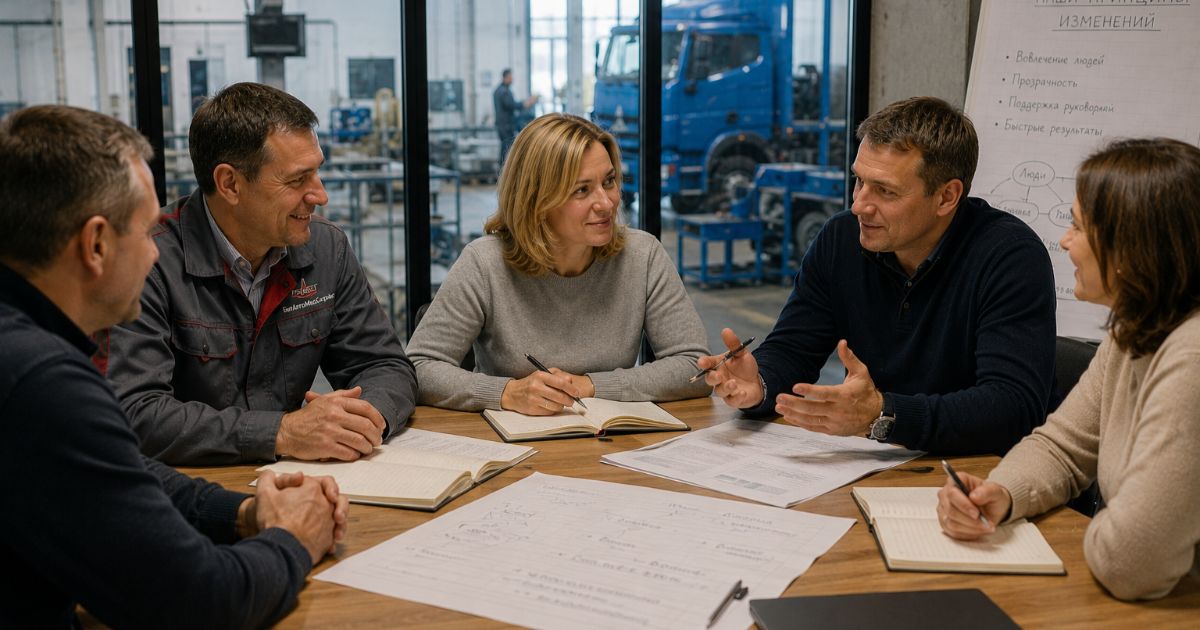
Case Study: How BelAvtoMazService Turned Change Implementation from a Project into Part of Its Management Culture
The main result was the company's ability to independently develop its own management system and adapt it to changing external conditions.
Read more All cases
Review of the change implementation project from Discovery group of companies
When we entered the project with Irina Sotnikova and the A.maze.S team, we understood: if we wanted to reach a different level of business, we needed a completely different approach to how the company itself was structured.
Read more All testimonials
«A durable integration skill helps a business handle any problem»
Every business problem is systemic in nature. They come from how companies respond to change — and that response leads to disintegration. We mean disintegration of everything and everyone: the interests of people, including owners and leaders, as well as business processes, organisational structure, the reward system, employee authority, and individual departments.
Read more All articles