It all started with a simple question: «Why do off-the-shelf business models so often fail to deliver what we actually need?» Over years of consulting, we came across a huge range of approaches — from theoretically perfect to hyper-specialised — but they rarely produced results that genuinely mattered for a real business, especially under constant change and market pressure. At a certain point, I realised that what was needed was a tool that not only accounted for the uniqueness of each company, but also helped it stay flexible and resilient. That is how the idea for the 8K Matryoshka tool was born.
The main tools I tried often oversimplified complex business challenges, or left important aspects in a blind spot — things like cause-and-effect relationships, the layered nature of a business model, and clarity around competitive advantage. The 8K Matryoshka is different: it is built around eight core elements and works as a universal framework that helps you understand and structure a business more deeply. The model works like a matryoshka doll — moving from the internal structure outward to the external boundaries, while clearly mapping the cause-and-effect relationships along the way. This approach lets you see the company as a whole, without losing any of the detail or the connections between the parts.
The 8K Matryoshka method is a modern tool for building resilient, adaptive business models. What makes it unique is that it accounts for every key element of a company — from its internal structure through to the external factors shaping the market. Unlike standard approaches, the 8K Matryoshka does more than clarify where a business currently stands — it helps uncover new growth opportunities by building out logical cause-and-effect relationships.
The name of the method symbolises reliability and flexibility: like a real matryoshka doll, a properly built model stays intact even when external conditions change. This approach makes it possible to identify weak spots, strengthen competitive advantages, and prepare the company for whatever challenges lie ahead.
Why 8K? How the number eight helps build a successful business strategy
The 8K Matryoshka method is built around eight key elements that help structure business strategy, surface the company’s strengths, and address its weaknesses. The number 8 was not chosen by accident — it symbolises infinity and continuous development, a reminder that managing a business should be an ongoing process focused on growth and resilience. The symbol also reflects the layered nature of the approach, where each element supports the next, just like a matryoshka doll.
The developers of the model found that the strongest strategies and analytical tools tend to consist of exactly eight components, and built that number into the concept itself. The 8K Matryoshka helps companies see the full picture of their business — from internal processes through to market impact. This approach brings clarity to management, while also helping the business stay flexible even in times of crisis.
The 8K Matryoshka concept
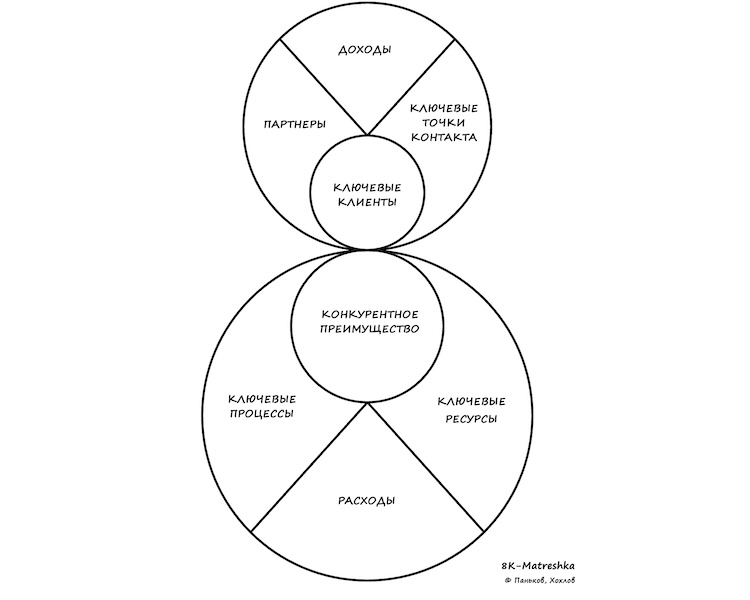
The 8K Matryoshka concept is built on a unique model that structures a business around eight key elements. Its structure mirrors a traditional matryoshka doll, where the smaller piece represents the foundation, and the larger one represents a comprehensive understanding of the whole business model. This analogy makes it possible to examine the company’s internal and external dimensions in detail.
The smaller doll contains two core elements: defining the target clients and the competitive advantages. These elements form the foundation of the business model, and its resilience depends on them. Mistakes here can result in a mismatch with market needs, or a loss of competitiveness.
The larger doll brings together the remaining six elements, revealing how they connect with and influence one another. It allows the business to be assessed as a unified system, splitting out four external aspects (the upper part) and four internal ones (the lower part). This approach simplifies the analysis of processes and makes it possible to build a resilient, flexible strategy that can adapt to changes in the market.
Breaking down each element
KEY CLIENTS
Key clients are the customer segments that will generate the bulk of your business’s profit for the foreseeable future. Defining these groups matters because it focuses all of the company’s efforts in the right direction. That doesn’t mean other client groups get ignored — the core goal is to understand whose needs should be met first, in order to maximise revenue.
It is worth keeping in mind that focusing on your primary clients doesn’t mean abandoning other segments entirely. The essence of it is identifying exactly who will generate most of your revenue, and concentrating your efforts on meeting their needs as fully as possible.
If your business operates on a model where one client group generates revenue from another — media outlets earning income through advertising, for example — you need to describe both groups: the ones who generate the revenue, and the ones whose needs you serve without their paying you directly.
Types of clients in the market
Active Users are clients who have a clear sense of their own needs and are actively meeting them through existing offers on the market. They know their way around the available options and have a strong awareness of how competitors differ from one another. Active Users often become loyal clients, and frequently act as informal experts whose opinions influence other people’s choices.
New Comers are consumers whose needs are at the stage of actively searching for a solution. These clients are often trying out different products from different companies, or making their first purchase. They may not have deep market knowledge and may struggle to tell offers apart, which makes them more open to experimenting with a new product or brand.
Not Comers are a group whose needs genuinely exist, but are not being met by what’s currently on offer. The reasons can vary — price that’s too high or too low, complexity of use, unsatisfactory service quality, or social, cultural, or infrastructural barriers. This group needs a solution that removes the obstacles to purchasing and makes the offer genuinely accessible to them.
Non Users are people for whom the need for the product or service simply doesn’t exist. They don’t think about this kind of value at all, which can stem from a lack of awareness, or from not understanding why the offer would matter to their life or business.
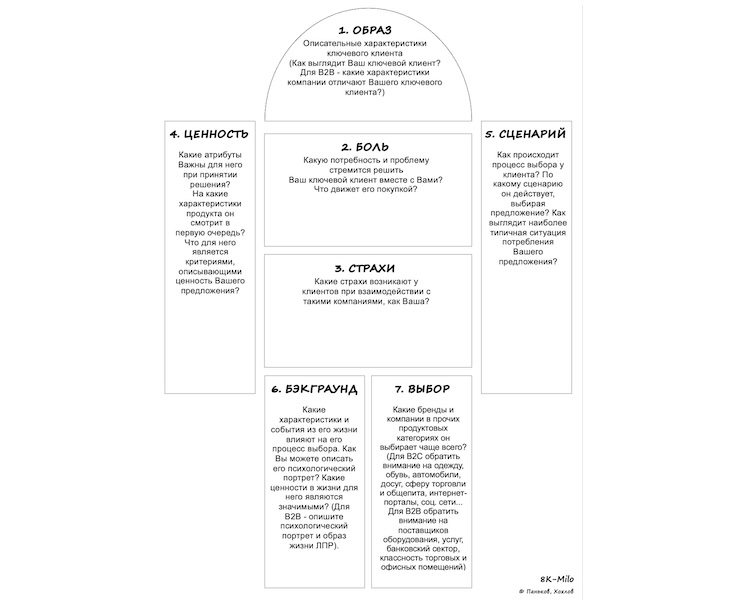
What matters in building the client profile?
- Formal characteristics
- What does the client satisfy through your service or product?
- What is the client’s pain point?
- What are clients afraid of when working with companies like yours?
- How does the decision process actually unfold? (the scenario)
- How does the decision process actually unfold? (the scenario)
For deeper work on client profiles, you can use the template for building client value:

You can download the templates here
We'll be glad if this approach resonates with you and you decide to use our methodology.
KEY REVENUE STREAMS
Key revenue streams is the part of the business model that describes the main sources of profit and how that profit is actually generated. To maximise revenue, it matters to understand which ways of working with clients will bring in the most profit. These can vary widely, and include things like payment deferrals, prepayments, margin levels, discounts, and add-on services.
Understanding exactly how your company makes money lets you fine-tune your strategy and optimise your processes. For example, you could offer clients different payment options — deferred or upfront — which can improve cash flow and reduce risk. Build a model that works for both sides, and pay close attention to mechanisms like the margin on the goods or services you sell.
Don’t overlook accounts receivable, either. This is one of the elements that can have a significant impact on your cash flow. Look for ways to reduce risk and speed up the collection of payments. Add supplementary services or bonus offers that can lift average order value, encourage repeat purchases, and improve client retention.
KEY TOUCHPOINTS
Not every client interaction carries equal weight. What matters is concentrating on the points where the client actually decides whether to work with you. Within the business model, you shouldn’t be trying to track every touchpoint — only the key ones, the ones that genuinely influence the decision to start or continue working with you.
In this section, you need to map out every key touchpoint that could bring clients to you, as well as the ones you plan to develop as part of your strategy. These are the moments that will decide whether clients keep working with you or switch to a competitor instead.
At these touchpoints, clients make decisions that are critical to your business:
- whether to start working with you at all;
- whether to continue the relationship or move to a competitor.
What needs to be diagnosed:
- An audit of every channel and touchpoint.
- Which channels exist, and whether they are actually attracting the target audience.
- Which channels are the primary ones.
- How to increase lead volume.
- Where and how new approaches can be tested.
KEY PARTNERS
To run more efficiently, your business may need partners — whether individuals or organisations. Partnerships can expand what’s possible, improve the quality of the work, and reduce risk.
Partners are generally needed in order to:
- reduce risk;
- gain access to target clients;
- provide target clients with additional services and value;;
- gain access to know-how and technology;
- improve control over the quality of the final product or service (for example, through freelance specialists, suppliers, or franchise partners)
KEY COMPETITIVE ADVANTAGES
A competitive advantage is a quality of the company that allows it to stand out from competitors in the eyes of clients, creating a market edge that can be sustained over time.
Competitive advantages define what makes the company’s offer unique for its chosen clients. It matters to have a clear understanding of which advantages matter most to your target audience, and which of them you are actually capable of building.
Describe which core competitive advantages matter to your target group, and which ones you can develop further. Also identify any additional advantages — reinforcing or connecting ones — that could be used to strengthen your strategy within the business model.
KEY PROCESSES
Key processes in a business model play a critical role in creating unique value for clients and reinforcing the company’s competitive advantages. These are the processes that give you the ability to deliver products and services that meet the needs of your target audience and set you apart from competitors.
In this section, you need to identify precisely which processes in your business model will be decisive in creating unique value for clients. These could be processes related to development, production, marketing, sales, or client service — anything that makes your offer unique and more appealing than what competitors provide.
Questions to answer:
- Which processes are vital to the success of our business model?
- Which key processes need to become more efficient in order to meet the needs of our key clients?
KEY RESOURCES
Key resources are the elements without which the business model simply cannot run effectively. They are what keeps the processes functioning and client needs met. It matters not only to understand what you already have, but also which resources need to be developed or added in order to successfully execute the strategy.
To effectively run your business model, you’ll need to draw on resources that fall into four main categories:
- Physical assets: all the tangible assets — buildings, production facilities, equipment, vehicles, and other resources that keep the business running.
- Intellectual assets: this includes software, technology, patents, databases, research and development, and other intangible assets that can be used to build competitive advantage.
- People: a key resource is qualified personnel with the right competencies, experience, and knowledge to carry out business processes and achieve the company’s goals. This can include internal staff as well as external consultants or partners.
- Finance: financial resources include your own investment, access to credit, working capital, and other financial instruments that provide the business with the funds it needs to grow and scale.
By answering the questions «What do we have?», «What’s missing?», and «What needs to be built up?» you’ll be able to pinpoint exactly which resources to improve or acquire in order to achieve long-term success in the business.
KEY COSTS
Costs are the group of expenses that make up a significant share of running the business model, and which need to be carefully managed. Cost management matters for maintaining financial stability and optimising profit.
What to keep in mind in this section:
- What should we keep our focus on? It is necessary to identify the main cost categories that need monitoring, particularly if they account for more than 5% of total costs.
- What is the trend in costs? You need to track how costs are changing over time, identify upward or downward trends, and understand what’s driving them.
- What have we done to reduce costs? It matters to keep track of the initiatives aimed at cutting or optimising expenses in order to improve the efficiency of the business.
The main cost categories to take into account:
- Fixed costs: expenses that don’t depend on sales volume and stay constant — rent, salaries, taxes, and other recurring costs. These need to be controlled and optimised to minimise their impact on profit.
- Investment costs: expenses tied to long-term investment in the business’s development — purchasing equipment, technology, expanding infrastructure, or investing in marketing campaigns. These costs are often substantial, but necessary for the company’s growth.
- Variable costs: expenses directly tied to sales volume — purchasing materials, output-based wages, commissions, packaging, and logistics. Managing variable costs effectively helps cut unnecessary spending and improve the business’s margins.
To successfully run a business model, each of these cost categories needs to be analysed carefully, with action taken to optimise them — helping improve both the company’s profitability and its resilience.
The 8K Matryoshka is a tool for building long-term strategies that helps a business adapt to change and thrive. It allows you to map out several strategic alternatives, analyse them, and choose the model that best fits your business. Each alternative needs to account for all 8 key elements: key partners, resources, processes, value propositions, channels, client relationships, client segments, and revenue structure.
Using the 8K Matryoshka matrix, you can develop at least three strategic options for the business, each accounting for the full range of risks and opportunities. By weighing the pros and cons, you then select the most effective business model — the one that becomes the foundation of your long-term strategy.
To help you avoid mistakes and genuinely work through your business model in depth, we offer a «Business Model Stress Test» service. Together with our experts, you will:
- Identify and address the weak points in your current business model.
- Assess how realistic your chosen strategy is and how well it adapts to changing conditions.
- Work through the key elements so that they reinforce one another and lead to real results.
How do you spot in time that your business model is starting to falter — and what do you do about it? Alexander Pankov talks through exactly this in the video «How to tell when your business model has stopped working.»
You might also be interested in

Case study: How Lyvin Properties moved from scattered action to a shared direction
This engagement wasn't about tasks. It wasn't even about strategy. It was about creating the space to stop, take stock, and reach genuine agreement — on what matters, what's real, and where the business is headed.
Read more All cases
Review of the strategy development project for ITG Solutions, a Kazakhstan-based integrator
When I came to Alexander, we had one simple but at the same time ambitious request — to understand where to go next, when the goal is not just to survive, but to change.
Read more All testimonials