A business model that worked three years ago may be your biggest constraint today. The market has changed. Your customers have changed. Your competitors have changed. But the way you make money may still be the same.
A business model upgrade is an intensive review of your current model with the team: where it works, where it breaks down, where it creates risk, and what needs to change so the business can grow rather than simply hold its position.
We do not do this work for you — we do it with you. Throughout the project, your team learns how to work with the business model independently. That capability is the most valuable asset the project leaves behind.
Why a business model that once worked can stop working
A business model is not a document. It is a set of choices and characteristics that define who your customer is, why they choose you, how the company makes money, and what drives its efficiency.
Over time, those characteristics become outdated. Customers change. A competitor serves your niche at a lower cost. A key partner leaves. Margins fall — not because the team is performing poorly, but because the model no longer reflects reality.
The challenge is that this is rarely visible from inside the business. When you work within it every day, familiar processes feel normal even when they have been holding the company back for years. An upgrade brings a fresh, structured view of the business model, supported by external experience.
Revenue is growing, but profit is not. The team is working harder without achieving better results, which means the model is becoming less efficient.

The market has changed: a strong competitor has entered, regulation has shifted or customer preferences have moved — while the business continues to operate in the same way.

Customers no longer buy the same products, in the same way or at the same price. It is unclear what has changed or how to respond.

The company has received investment, entered new markets or launched new products, and now needs to adapt its model to support them.

The business has grown or contracted, and the old management and revenue model no longer fits its new scale.

Key suppliers or partners that supported the model have changed, and you need to understand what must be rebuilt.

You want to grow three to five times, but cannot see what in the current model is preventing that growth.

You feel the business is operating below its potential, but the bottleneck is difficult to identify from the inside.
What happens during the business model upgrade
This is not an audit that ends with a report sitting on a shelf. Nor is it a consulting project where the consultant leaves behind recommendations and the team is left wondering what to do next.
It is structured work carried out by your management team together with our consultants. We review the current model element by element, identify weaknesses and risks, and create a one-year change plan.
The project uses our proprietary 8K methodology, a tool tested in dozens of companies across different industries. Your team does more than participate: it learns how to apply the tools independently, making it possible to repeat this work later without an external consultant.

Learn more about the methodology
After you complete the form, you will receive a link to download an archive containing Alexander Pankov’s book “The 8K Labyrinths of Strategy”, published by Mann, Ivanov and Ferber. The archive includes EPUB, MOBI and PDF formats.
How the project works
- Step 1: Define the owners’ vision
- Step 2: Describe and review the current business model
- Step 3: Map the risks and weak points
- Step 4: Build a one-year transformation plan
- Step 5: Present and approve the results
We work with you, not instead of you.
The consultant does not disappear to “prepare a report” and return with ready-made answers. All work happens with the team: we facilitate, guide and add expertise, but your people develop the decisions. As a result, the team understands the logic behind the changes and is ready to implement them.
We do not leave without a plan. The project ends with a practical one-year action plan, not just a diagnosis. It includes owners, deadlines and success criteria.
We transfer tools, not just conclusions. During the project, your team learns how to use the business model review methodology. After the project, you can repeat the work independently without hiring consultants again.
Our approach is backed by 20 years of work in strategy and organisational effectiveness. We have seen business models succeed and fail across dozens of industries. During the sessions, we do more than facilitate the process: we recognise when the model’s logic is leading to a dead end and say so directly.

A detailed description of the current business model. For many companies, this is the first time they see less obvious aspects of their own business clearly.

A prioritised risk map showing what is critical, what is important and what does not require attention yet.

A clear understanding of exactly what is preventing significant growth — specific weak points rather than a general feeling.

A one-year transformation plan covering initiatives, activities, owners and deadlines.
A team that understands the logic behind the changes and is ready to implement them because it helped design them.

The 8K methodology tools the team can continue using independently.
Project Expert

Aliaksandr Pankou
Co-Founder of A.maze.S

Tell us about your situation — we’ll help you identify the right solution

You may also be interested in
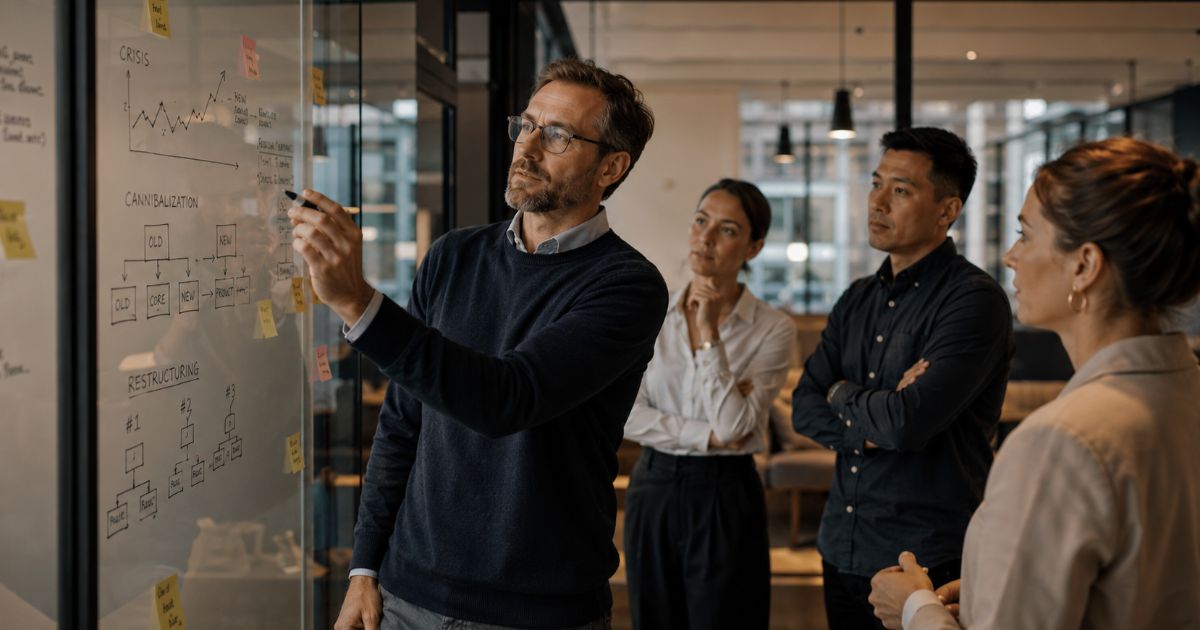
Case Study: How a company navigated three waves of strategic transformation, retained its entire team, and became a product-led business
An inside account of the engagement — from the perspective of the consultants who guided the organization through successive crises, deliberate self-disruption, and three structural rebuilds.
Read more All cases
Review of the strategy development project for ITG Solutions, a Kazakhstan-based integrator
When I came to Alexander, we had one simple but at the same time ambitious request — to understand where to go next, when the goal is not just to survive, but to change.
Read more All testimonials
The 8K proprietary methodology for building and evaluating a business model
The 8K method helps you not only understand where your business currently stands, but also identify new growth opportunities by mapping out clear cause-and-effect relationships.
Read more All articles