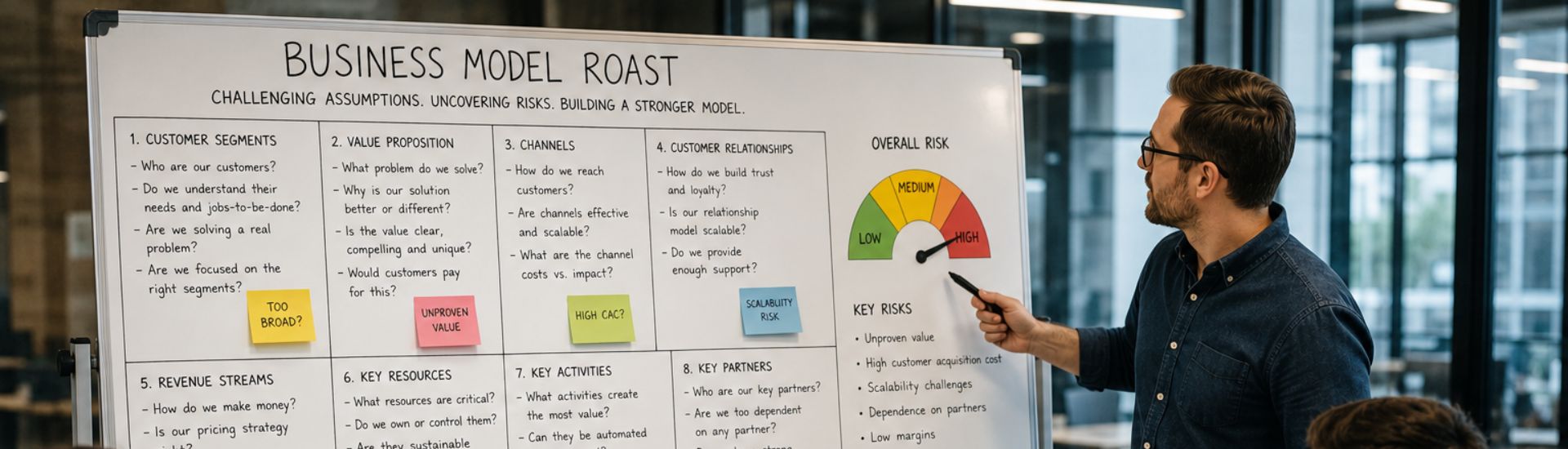
The «business model stress test» is a modern approach to a deep analysis of an existing business model, with the goal of identifying its weak points and improving overall performance. This process allows entrepreneurs not only to get clear answers about successfully launching new business ideas, but also to assess what resources will be needed to bring them to life. Beyond that, the stress test helps uncover vulnerable links in the business structure and develop concrete measures to address them.
When is it worth running a business model stress test?
This method is particularly relevant when facing the following challenges:
— Slowing business growth and hitting the current limits of scaling;
— Revenue growing without a corresponding increase in net profit;
— The loss of strategically important clients;
— Difficulty scaling the business further;
— The emergence of strong new competitors in the market;
— No clear plan for entering new markets;
— Negative experience with previous projects;
— Difficulty retaining employees.
How the stress test process actually works?
The stress test process involves a step-by-step analysis that helps owners and company leaders gain a clear assessment of their current business model. This makes it possible not only to identify weak points, but to find ways of addressing them. By applying this approach, companies get the chance to move to a new level — resolving existing problems or building the foundation for future growth. A thorough examination of every aspect of the business model — from the value chain through to promotion strategy — helps make the changes needed to reach the goals that have been set.
What difficulties can arise when running the stress test on your own?
There are various methodologies for optimising business models — but when companies try to apply them on their own, a number of problems can arise:
- Lack of experience and expertise. Different problems require different approaches, and a lack of professional knowledge can negatively affect the outcome.
- Employee bias. Key employees can be biased in their assessments, which makes it harder to take an objective look at the current model. Employees are often confident their company is already operating at its best, which can get in the way of genuinely critical analysis.
- Difficulty identifying weaknesses and strengths. A company’s successes are often taken as the norm, while its weaknesses get ignored or underestimated.
How to avoid these difficulties?
For the stress test process to run smoothly and effectively, it matters to:
— Follow a proven analytical methodology;
— Bring in an external expert to run the process and provide an objective assessment;
— Use a pre-prepared script for discussing the business model;
— Bring in independent expertise so that every team member’s perspective is taken into account;;
— Ensure the team shares a unified view of how the business model should be optimised.
How to run a business model stress test in Kazakhstan?
If you’re interested in studying in detail the methods and tools that will help you run an effective business model stress test in Kazakhstan, we offer a dedicated training programme:
You might also be interested in

Case study: How Lyvin Properties moved from scattered action to a shared direction
This engagement wasn't about tasks. It wasn't even about strategy. It was about creating the space to stop, take stock, and reach genuine agreement — on what matters, what's real, and where the business is headed.
Read more All cases
Review of the strategy development project for ITG Solutions, a Kazakhstan-based integrator
When I came to Alexander, we had one simple but at the same time ambitious request — to understand where to go next, when the goal is not just to survive, but to change.
Read more All testimonials